
Gravity
Make it make sense....

Gravity is one of the things that we take as a given in our daily lives. It's such a given that I wonder how many of us have ever stopped to ask… "Why?" Why down and not up? Why any specific direction at all… why couldn't it just move things in random directions? The concept that something stays still unless something else moves it also feels so normal… but then if you hold something out and let go of it… it just starts moving downward! No effort required! And we just accept this because it's "normal." But just because something seems normal doesn't mean we can't ask- "Why?"
Plenty of people have wrestled with gravity throughout human history. Perhaps the most famous was Sir Isaac Newton, who apocryphally questioned gravity after an apple fell out of a tree and hit him on the head. Regardless of his motivations, his results were "fruitful."1 In the late 1600's, Newton created the first mathematical equations for gravity. I won't subject you to the mathematical formulas here (they're actually not very complicated). Essentially, Newton established that gravity acts between any two objects with mass. The more mass something has, the more gravity it generates. What's crazy is he did such a good job at it that NASA used his gravity formula to land on the moon. Not too shabby! But what's also crazy is that despite developing a very accurate model of what gravity does, there were two issues: 1. There were some slight inconsistencies with our observations in the real world and 2. He didn't actually tell us what gravity IS. He told us what it DOES, but not it IS. On this very question, Newton himself wrote "Hypothesis non fingo," which is Latin for roughly "Beats the hell out of me." So what IS gravity?
Enter Albert Einstein. I mentioned in a past article that Einstein wrote two theories of Relativity and introduced us to the concept of space-time- three spatial dimensions and one time dimension. These rewrote the rulebook for physics and General Relativity rewrote the rulebook for gravity. Spoiler alert… we still don't really know what it IS. BUT! We have an even more accurate description of it now than Newton gave us. It's infuriating really…. Our current theory of gravity is so precise that we made absolutely bonkers predictions (light bending, black holes, gravitational waves, the list goes on) decades before we could prove they were true. Our current understanding of how gravity behaves is so precise with General Relativity that we have inferred that most of the mass in the universe is invisible to and untouchable by us (dark matter). That is a ridiculous claim, but THAT is how confident we are in our current model of gravity.
So what does General Relativity tell us about gravity? To start with, we'll go back to geometry. For most of us mere mortals, our concept of geometry is based on what is called Euclidian geometry. Don't overthink it, Euclidian geometry is exactly what you think geometry is- lines, angles, and shapes on a page. The operating assumption here is that the space we use for Euclidian geometry is flat and two dimensional. Think of a page of paper. Draw two parallel lines on a flat sheet of paper and you get… two parallel lines.
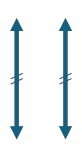
Will these lines ever cross? No, that's what makes them parallel. But what happens to geometry if space isn't "flat?" Sounds like a nerdy concept that we have no hope of understanding, right? But if that was the case, I wouldn't be writing about it. So let's dive in. Pretend you and a friend both live at the equator, hundreds of miles apart from each other. For whatever reason you decide, you both agree to fly to the North Pole. Let's chart this on a map.
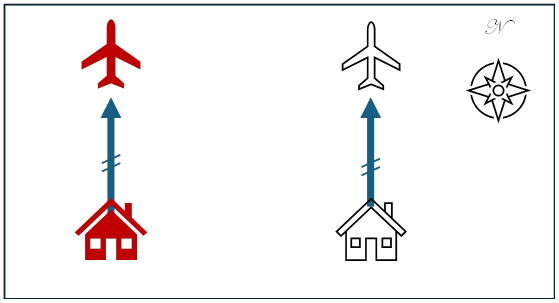
You're both flying due North, so notice how your routes on this flat map, this "flat space," are parallel to each other? So that means your routes should never intersect, right….? But now let's look at your routes on a globe.
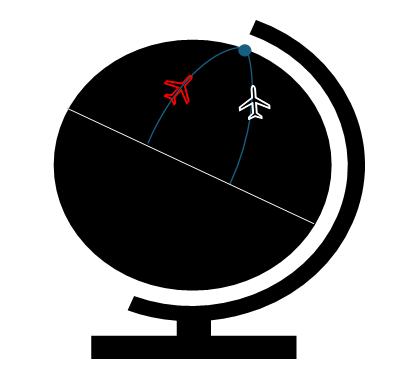
Your parallel routes, routes that do not converge in flat space, actually end up converging! That's because geometry on a globe isn't flat space, it's curved space! This is the same reason Greenland on a flat map looks way bigger than it really is. Geometry in curved space and geometry in flat space play by different rules.
So now we have an intuitive foundation for accepting that curved space and curved geometry are not that scary. This is important because in General Relativity, Einstein told us that matter curves the space-time around it. That means to understand what's happening around us, we should actually be using some type of curved geometry! So what does this mean for gravity?
Let's try another thought experiment. Imagine a giant race track that's shaped like a ring suspended in the air. The surface of the track is the inside of the ring.
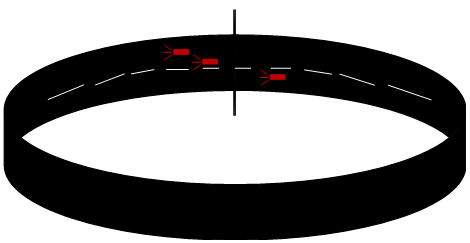
If you drive fast enough, you could drive on the inside of the ring and not fall off, right? What would that even look like to you if you were the race car driver? Probably a pretty boring track…. You're literally just driving in a straight line forever. Wait…. a straight line? But you're driving in circles…. Yup, and we just unknowingly described why the earth orbits the sun. To the earth, it's just flying through space in a straight line, minding its own business. But the sun's gravity curves the space around the sun, similar to how our perfectly straight race track is curved around the inside of a ring. The Earth's path of a straight line through the sun's curved space turns its route into a circle2 and voila! The sun's gravity causes Earth to orbit the sun in a circle even though Earth is just travelling in a straight line.
So now we're going to get a little trippy. If you don't want that, then stop reading right here and be happy with the explanation so far.
Still with me? The lines we've been travelling along, whether flying to the North Pole or driving around a ring track have a nerdy name- they're called "world lines" or "geodesics." A world line belongs to a specific object or person and charts their position in space-time for their entire existence. Geodesics are properties of space-time and follow the curvature of space. They provide the shortest distance between two points accounting for the curvature of space-time.
Think of your route to the North pole; you travelled as straight as possible, but a truly straight line would have tunneled you right through the surface of the earth. You didn't do that; you, your worldline more specifically, followed the geodesic that took you to the North Pole accounting for the curvature of the earth. Every object has a world line through space-time and its world-line will follow the paths of least resistance- a geodesic.
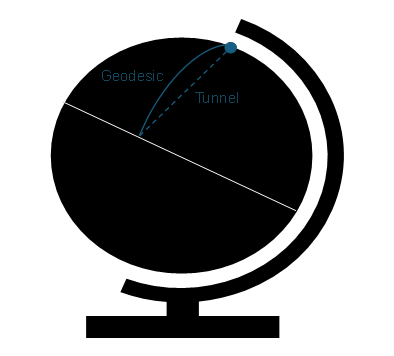
Ok, so to bring this all together. How does curved space make objects simply fall to the ground? Picture it, you’re holding something in your hand, you let go, and it just starts moving down. What's happening here? Why does an object begin falling from a standstill when you drop it? Because even when something is standing still, it's still travelling through space-time (not just space!) along its worldline. This worldline through space-time follows a geodesic, and the geodesic is part of curved space-time into the earth. Thinking of this another way, staying still and simply travelling through time curves your position into the earth. Similar to how you and your friend converged at the North Pole even though you started off on parallel paths!
So none of this explained what gravity actually is, because the truth is we don't really get it. But at least now we can understand that gravity is not some invisible force that radiates from a planet or a star. Gravity is the name we give to the paths of our world lines when the geodesics they follow get curved. Many scientists are (understandably) not satisfied with this explanation because, in fairness, it's not an explanation. We're back to Newton's "Hypothesis non fingo;" matter distorts space-time, but we don't know why. At least I told you upfront we don't know! Gravity remains stubbornly outside of our other most important theory of Physics, Quantum Mechanics. If we could unite Relativity with Quantum Mechanics, which is widely considered one of, if not THE, greatest questions in physics, that could give us the Holy Grail of science- The Theory of Everything, but that's another topic :-)
I won't do that again, I swear.
Technically an ellipse, but it's the same concept for our purposes.